



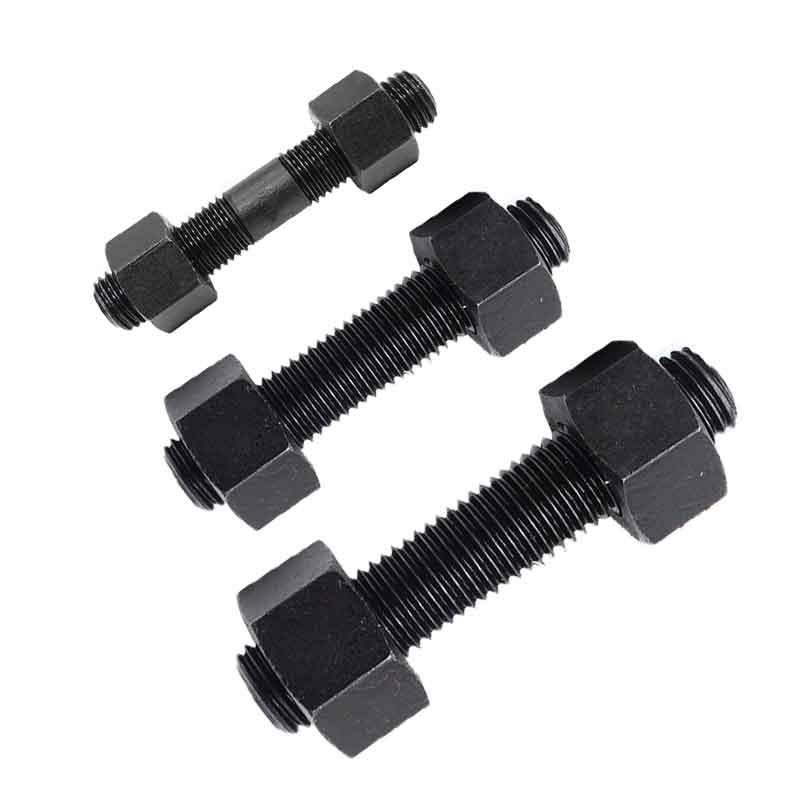
DIN985 stainless steel anti loosening nut hexagonal self-locking nut 304 nut nylon anti slip screw cap non-metallic
The anti loosening nut originated from abroad. It is permanently attached to the thread with special engineering plastic, which causes a strong reaction force to be generated when the engineering plastic is squeezed during the tightening process of the internal and external threads, greatly increasing the friction between the internal and external threads and providing absolute resistance to vibration. This resistance is completely distributed throughout the entire engagement section of the internal and external threads, and the frictional force is independent of the tightening pressure between the internal and external threads. Unlike previous anti backlash methods, it relies on the frictional force generated by the pressure after the screw is tightened to prevent backlash. Once the screw is slightly loosened and the pressure decreases, the frictional force quickly disappears and loses its anti backlash effect, causing the screw to loosen. However, the plastic anti loosening method is affected by the environment and cannot meet the requirements of high temperature and severe cold. It is necessary to explore a new anti loosening technology. Anti loosening nuts were invented in the United States 35 years ago, with a 30 degree wedge surface at the top of the traditional 60 degree tooth tip. This structure allows the bolt to gain greater friction between the male and female threads after tightening with the nut, achieving anti loosening compared to traditional threads. Due to the change in the angle of the tooth shape, the normal force generated by the contact between the threads forms a 60 degree angle with the bolt axis, instead of the 30 degree angle seen with regular threads. The normal pressure of the thread is much greater than the fastening pressure, so the anti loosening friction force generated is inevitably greatly increased. When the male thread crest is engaged with the female thread, the tooth tip at the crest is prone to deformation, allowing the load to be evenly distributed over the entire length of the spiral line in contact, avoiding the phenomenon where more than 80% of the total load is concentrated on the thread surfaces of the first and second teeth during normal standard thread engagement. Therefore, threaded coupling not only overcomes the disadvantage of easy self loosening under vibration conditions of ordinary standard coupling, but also extends its service life. Due to this special tooth deformation anti loosening method, it can be disassembled 5 to 50 times repeatedly, and the anti loosening function still persists. Due to its high anti vibration, lightweight, and repeatable disassembly, this anti loosening method has become the most reliable anti loosening product today. Screws that have undergone anti loosening treatment are called anti loosening screws, which are most suitable for fastening moving parts. They were first used on American spacecraft and later promoted to the American automotive manufacturing industry. With the maturity of manufacturing technology and the reduction of costs, they are widely used in multiple industries such as 3C, bicycles, ice skating and skiing equipment, furniture, sports equipment, medical equipment, etc., fully replacing traditional anti loosening washers and fully demonstrating the reliability of the fastening and anti loosening effect of anti loosening screws.