



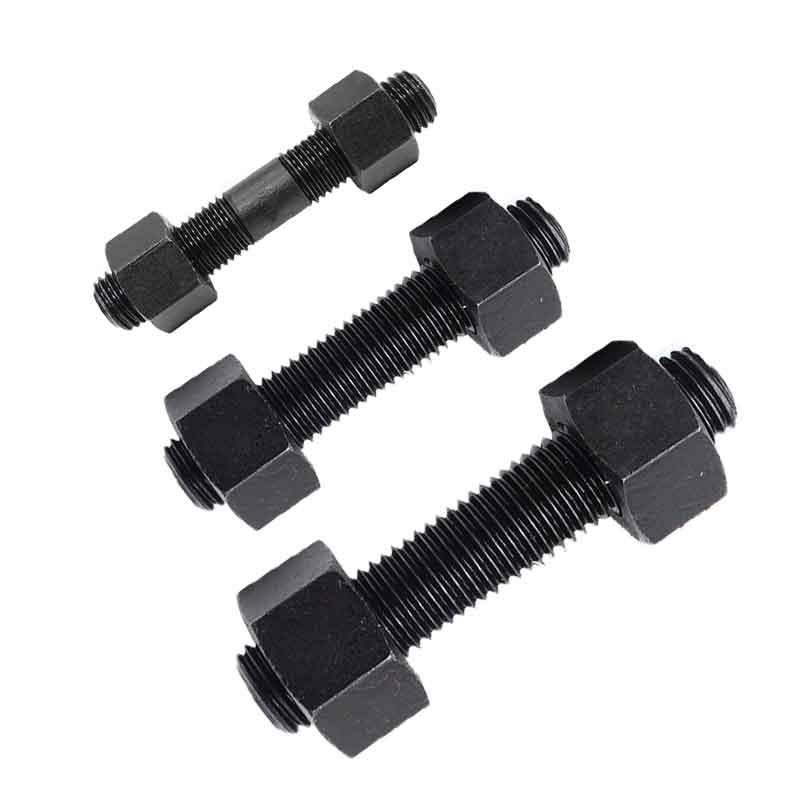
An external hexagonal bolt is a metal accessory, also known as an external hexagonal screw, external hexagonal screw, or external hexagonal bolt.
9. High strength bolts are generally made of high-strength steel (45 steel (8.8s), 20MmTiB (10.9s), which are prestresseD Bolts. Friction type bolts are pre-stressed with a torque wrench, and pressure type bolts are screwed off with a plum blossom head. Ordinary bolts are generally made of ordinary steel (Q235) and only need to be tightened.
10. Ordinary bolts are generally grade 4.4, 4.8, 5.6, and 8.8. High strength bolts are generally classified as 8.8 grade and 10.9 grade, with 10.9 grade being the most common.
11. The screw holes of ordinary bolts may not necessarily be larger than those of high-strength bolts. In fact, ordinary bolt holes are relatively small.
12. Ordinary bolt A and B level screw holes are generally only 0.3-0.5mm larger than the bolt. C-grade screw holes are generally 1.0-1.5mm larger than bolts.
13. Friction type high-strength bolts transmit loads through friction, so the difference between the screw and the screw hole can reach 1.5-2.0mm.
The standard force transmission characteristics of pressure bearing high-strength external Hexagon Bolts are to ensure that under normal use, the shear force does not exceed the friction force, which is the same as that of friction type high-strength bolts. When the load increases further, relative sliding will occur between the connecting plates. The connection relies on the shear resistance of the screw and the pressure on the hole wall to transmit force, which is the same as ordinary bolts. Therefore, the difference between the screw and the screw hole is slightly smaller, ranging from 1.0 to 1.5mm.
Column base anchor bolt
19. Anchor bolts have no grade, only materials: Q235 and Q345. The most commonly used anchor bolts in building structures are column foot anchor bolts.
20. Column foot anchor bolts are neither ordinary bolts nor inferior to high-strength bolts. Strictly speaking, it does not belong to bolts. The column base anchor bolt is generally M20 or M24.
The manufacturing standards for column foot anchor bolts should be the same as those for ordinary bolts. The length of the anchor bolt purchased for the column base should be related to the frictional force between it and the concrete, as well as the form of the anchor bolt.
Expansion bolts and chemical bolts
22. Whether it is expansion anchor bolts or chemical anchor bolts, they are not the connection forms in the national standard specifications, and such connections should be avoided, especially in important connections. Pre embedded parts should be used for all.
23. The expansion anchor bolt mainly relies on the opening of the expansion pipe cabinet and the frictional force generated by the concrete to resist pulling. The magnitude of the tensile strength is closely related to the construction process, and there are significant human factors involved. Therefore, conducting tensile tests through random inspections is also useless.
24. Chemical anchor bolts are formed by punching holes with a punching machine, inserting the bolt rod, and then injecting chemical slurry to achieve anchoring effect. Common brands such as Huiyu and Heineken.
Expansion bolts and chemical bolts actually belong to anchor bolt properties. In some cases, expansion bolts or chemical anchor bolts are needed because they are not pre embedded. But this situation should be avoided in the design. Because anchor bolts should be pre embedded. For example, column foot anchor bolts. Because only in this way can we ensure optimal adhesion and stress. Moreover, punching holes afterwards often affects the stressed steel bars and concrete in the concrete