



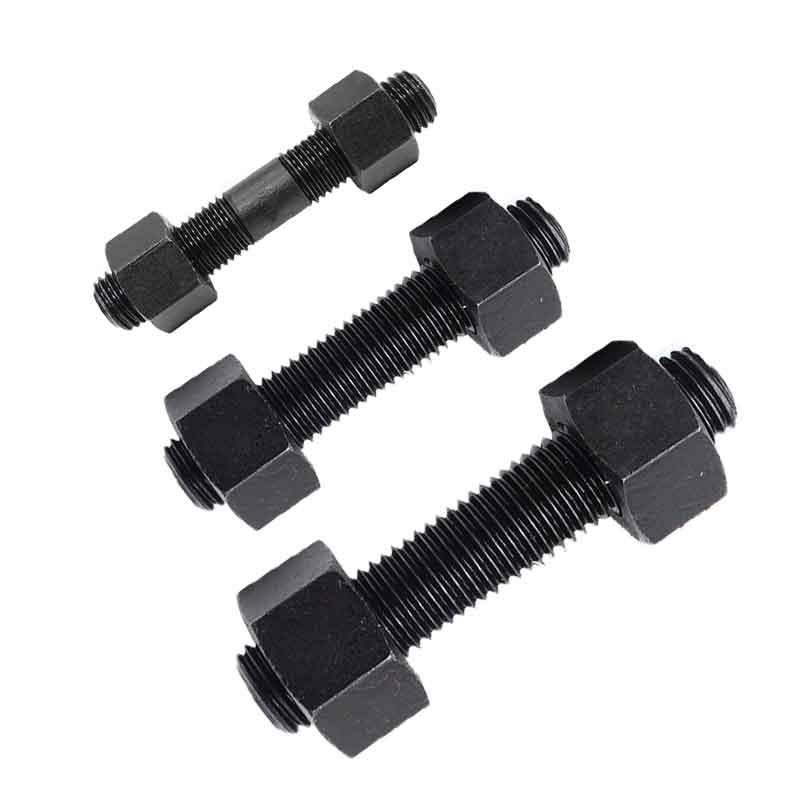
Plum blossom with column self tapping screw
In addition to differences in basic dimensions such as head to edge and head thickness, the most important difference in standards is the difference in threaded parts. The threads of GB, DIN, JIS, etc. are all measured in millimeters (MM) and are collectively referred to as metric threads. Threads such as ANSI, ASME, etc., which are measured in inches, are called American standard threads. In addition to metric threads and American threads, there is also a BSW British standard, whose threads are also measured in inches, commonly known as Wyeth threads.
Metric threads are measured in millimeters (MM) and have a tooth tip angle of 60 degrees. Both American and British threads are measured in inches. The tooth tip angle of American thread is also 60 degrees, while the tooth tip angle of British thread is 55 degrees. Due to different units of measurement, the representation methods of various threads are also not the same. For example, M16-2X60 represents metric threads. His specific meaning is that the nominal diameter of the screw is 16MM, the pitch is 2MM, and the length is 60MM. For example, 1/4-20X3/4 represents the British thread, and his specific meaning is that the nominal diameter of the screw is 1/4 inch (one inch=25.4MM), with 20 teeth on one inch and a length of 3/4 inch. In addition, when referring to American Screws, UNC and UNF are usually added after representing British screws to distinguish between American coarse teeth and American fine teeth.
In our daily domestic sales business, the standards we most commonly encounter are GB (National Standard) and DIN (German Standard).
In terms of non aromatic products, the following standards are mainly encountered: GB30; GB5783; GB5782; GB62; GB6170; GB818; GB819; GB845; GB846; GB70; DIN912; DIN933; DIN931, etc. At present, GB30 (old national standard) has been replaced by GB5783 (new national standard) in the standard book. GB52 (old national standard) has been replaced by GB6170 (new national standard) in the standard book.
In 1986, our country formulated a new standard for standard components, commonly known as the new standard in business. The most commonly used ones are GB5780, GB5781, GB5782, GB5783, and GB5784. GB5780 is a hexagonal head thick rod half tooth screw with a precision level of C, which can be replaced by GB5782 (GB5782 is a hexagonal head thick rod full tooth screw with a precision level of A and B). GB5781 is a hexagonal head full tooth screw with a precision level of C. GB5783 can be used as a substitute (GB5783 is a hexagonal head full tooth screw with accuracy levels of A and B). GB5784 is a hexagonal screw with a thin rod and half tooth.
The difference between the new label and the old label is that the M8, M10, M12, M14, and M22 series products have differences in the width of the edges. Except for the new M22 series products, the head edges of the new label products M8, M10, M12, and M14 are 1MM smaller than those of the old label. They are 13mm, 16mm, 18mm, and 21mm respectively. However, for the new M22 series products, the opposite side of the new label is actually 2MM larger than the old label, so special attention should be paid. For the thickness of the head, there is a slight difference between the new and old standards, which can be used interchangeably in situations where the requirements are not very strict.
The difference between the new standard and the German standard lies in the product specifications of M10, M12, M14, and M22, which differ in the width of the edges. The head to edge new standard of M10, M12, M14 should be 1MM smaller than the German standard. The new product of M22 has a head edge width that is 2MM wider than the marked edge width, and all other products can be used interchangeably.
For Hexagonal Nuts, commonly used standards include GB52, GB6170, GB6172, and DIN934. The main difference between them is that GB6170 is thicker than GB52, GB6172, and DIN934, commonly known as thick nuts. In addition, there is a difference in the edges. In the M8 nut series, the edges of DIN934, GB6170, and GB6172 are 13mm, which is 1MM smaller than the 14mm edge of GB52. For M10 nuts, the edges of DIN934 and GB52 are 17mm, which is 1MM larger than the edges of GB6170 and GB6172. For M12 nuts, the edges of DIN934 and GB52 are 19mm, which is 1MM larger than the 18mm edge of GB6170 and GB6172. For M14 nuts, the opposite edge of DIN934 and GB52 is 22mm, which is 1MM larger than the opposite edge of GB6170 and GB6172, which is 21mm. In addition, the M22 nut has a 32MM opposite edge to DIN934 and GB52, which is 2MM smaller than the 34MM opposite edge to GB6170 and GB6172. GB6170 and GB6172 have exactly the same edge width except for their different thicknesses. All other specifications can be used interchangeably without considering thickness.