

Leave Your Message
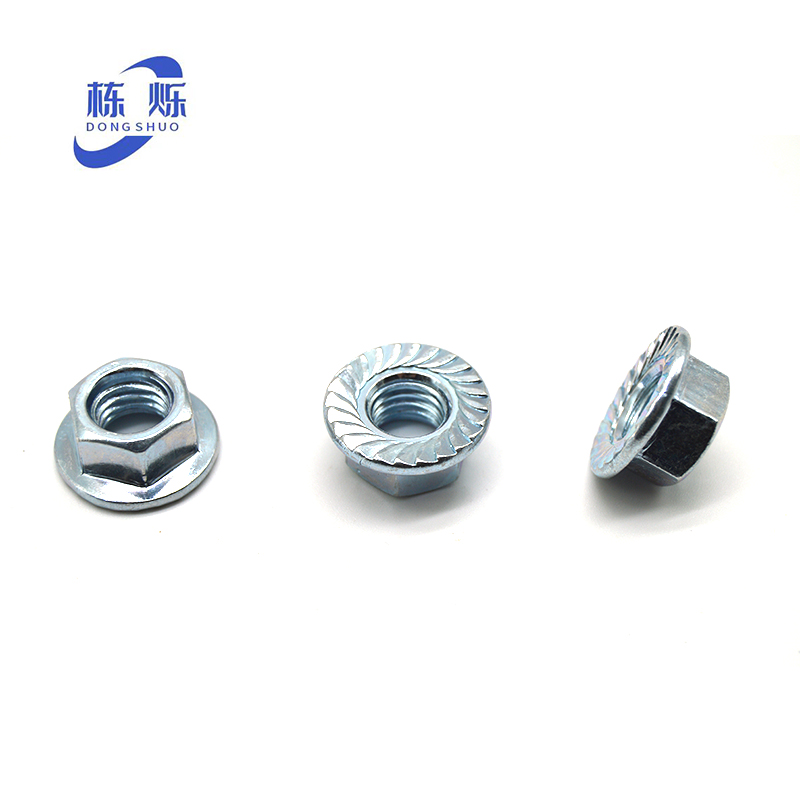
China Suppliers Factory Galvanized Hexagonal Flange Nut 4.8 8.8 Grade 12.9 Thickened Flange Nut for Mechanical Equipment
Hot Products

China Suppliers Factory Galvanized Hexagonal Flange Nut 4.8 8.8 Grade 12.9 Thickened Flange Nut for Mechanical Equipment

The flange nut, a vital component in mechanical equipment, offers easy maintenance and disassembly. Commonly used by China suppliers and factories, these nuts connect shafts, hubs, and other critical parts without the need for specialized tools. This design greatly simplifies daily maintenance and repair tasks, making it an essential choice for efficiency in various applications. Whether you're sourcing from China suppliers or looking to stock your factory, flange nuts provide a reliable solution for your mechanical needs

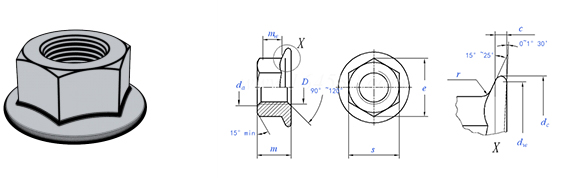
    DIN 6923 hexagon flange nut
    Thread Dimension Specifications
    Thread specifications
    D
    M5 M6 M8 M10 M12 M14 M16 M20
    P Pitch Coarse teeth 0.8 1 1.25 1.5 1.75 2 2 2.5
    Fine Teeth 1 / / 1 1.25 1.5 1.5 1.5 1.5
    Fine Teeth 2 / / / -1 -1.25 / / /
    c Min 1 1.1 1.2 1.5 1.8 2.1 2.4 3
    Min Min 5 6 8 10 12 14 16 20
    Max 5.75 6.75 8.75 10.8 13 15.1 17.3 21.6
    dc Max 11.8 14.2 17.9 21.8 26 29.9 34.5 42.8
    dw Min 9.8 12.2 15.8 19.6 23.8 27.6 31.9 39.9
    e Min 8.79 11.05 14.38 16.64 20.03 23.36 26.75 32.95
    m Max 5 6 8 10 12 14 16 20
    Min 4.7 5.7 7.6 9.6 11.6 13.3 15.3 18.9
    mw Min 2.2 3.1 4.5 5.5 6.7 7.8 9 11.1
    s Maximum = nominal 8 10 13 15 18 21 24 30
    Min 7.78 9.78 12.73 14.73 17.73 20.67 23.67 29.67
    r Max 0.3 0.36 0.48 0.6 0.72 0.88 0.96 1.2
    1. Material:
    a) Steel, strength grade (material): 8, 10, 12 — DIN ISO 898-2, DIN 267-23 (current draft)
    b) Stainless steel, strength grade (material): A2-70 — DIN 267-11
    c) Other material or grade chosen by the manufacturer
    Key Applications & Benefits

    Flange nuts have a wide range of applications in the industrial field, especially in mechanical equipment such as compressors, pumps, air conditioners, and fans, playing a crucial role.

    • 1
      Additional Support & Protection

      Due to the fact that flange nuts are integrated with washers and nuts, their wide flange design can increase the contact area with the workpiece surface, providing better support and protecting the connecting components. This structure makes it more sturdy and has greater tensile strength than a regular combination of hexagonal nuts and washers.

    • 2
      Prevent Loosening & Improve Sealing

      The anti-slip teeth and serrated protrusions under the flange nut can evenly distribute the pressure of the nut on the fixed component, creating a locking effect to prevent loosening. At the same time, they can also improve the sealing of the connection, effectively preventing gas or liquid leakage.

    • 3
      Shock Absorption & Noise Reduction

      Good flange nuts can to some extent reduce the vibration and noise generated by equipment operation, thereby improving the stability and operational efficiency of the equipment.

    Frequently Asked Questions
    Q What is a DIN 6923 hexagon flange nut?
    A DIN 6923 hexagon flange nut is a type of fastener that combines a standard hexagonal nut with an integrated wide flange at its base. The flange acts as a built-in washer, distributing the clamping load over a larger surface area. It is manufactured and dimensioned in accordance with the German DIN 6923 standard, covering thread sizes from M5 to M20 and beyond.
    Q What materials are DIN 6923 flange nuts available in?
    DIN 6923 flange nuts are commonly available in steel (strength grades 8, 10, and 12 per DIN ISO 898-2 and DIN 267-23) and stainless steel (grade A2-70 per DIN 267-11). Other materials or grades may also be used depending on the manufacturer's specifications and the application requirements.
    Q What is the difference between coarse thread and fine thread flange nuts?
    Coarse thread flange nuts have a larger pitch (greater distance between threads) and are the most common type, suitable for general-purpose fastening. Fine thread nuts have a smaller pitch, which provides higher thread engagement strength, better resistance to loosening under vibration, and more precise torque control. Fine thread options are available for sizes M8 and above in DIN 6923.
    Q Why do flange nuts resist loosening better than standard hex nuts?
    Flange nuts feature serrated or anti-slip teeth on the underside of the flange. These teeth bite into the mating surface when the nut is tightened, creating a mechanical locking effect that significantly resists vibration-induced loosening. This makes them ideal for applications subject to dynamic loads, such as compressors, fans, and automotive assemblies.
    Q In which industries are DIN 6923 flange nuts most commonly used?
    DIN 6923 flange nuts are widely used across many industries, including HVAC (air conditioners and fans), industrial machinery (compressors and pumps), automotive manufacturing, construction equipment, and general mechanical engineering. Their ability to provide secure fastening, improved sealing, and vibration resistance makes them a preferred choice wherever reliable connections are essential.
    Q Can DIN 6923 flange nuts be reused after removal?
    While DIN 6923 flange nuts can technically be removed and reinstalled, it is generally recommended to use new nuts for critical applications, especially those with serrated flanges. The serrations can wear down after repeated use, reducing their locking effectiveness. For non-critical or low-vibration applications, reuse may be acceptable if the nut and mating surface show no signs of damage or deformation.